The Primary Causes of Flickering and Dimming Lights in Bothell
Understanding why lights flicker requires distinguishing between isolated fixture issues and whole-house voltage fluctuations. When a single lamp or fixture flickers, the problem is usually a loose bulb, an incompatible dimmer switch, or a deteriorating socket contact. But when lights dim across multiple rooms simultaneously, or when lights in one room flare unusually bright while lights in another dim, your home is likely experiencing a severe electrical hazard known as an 'open neutral' or 'floating neutral.'
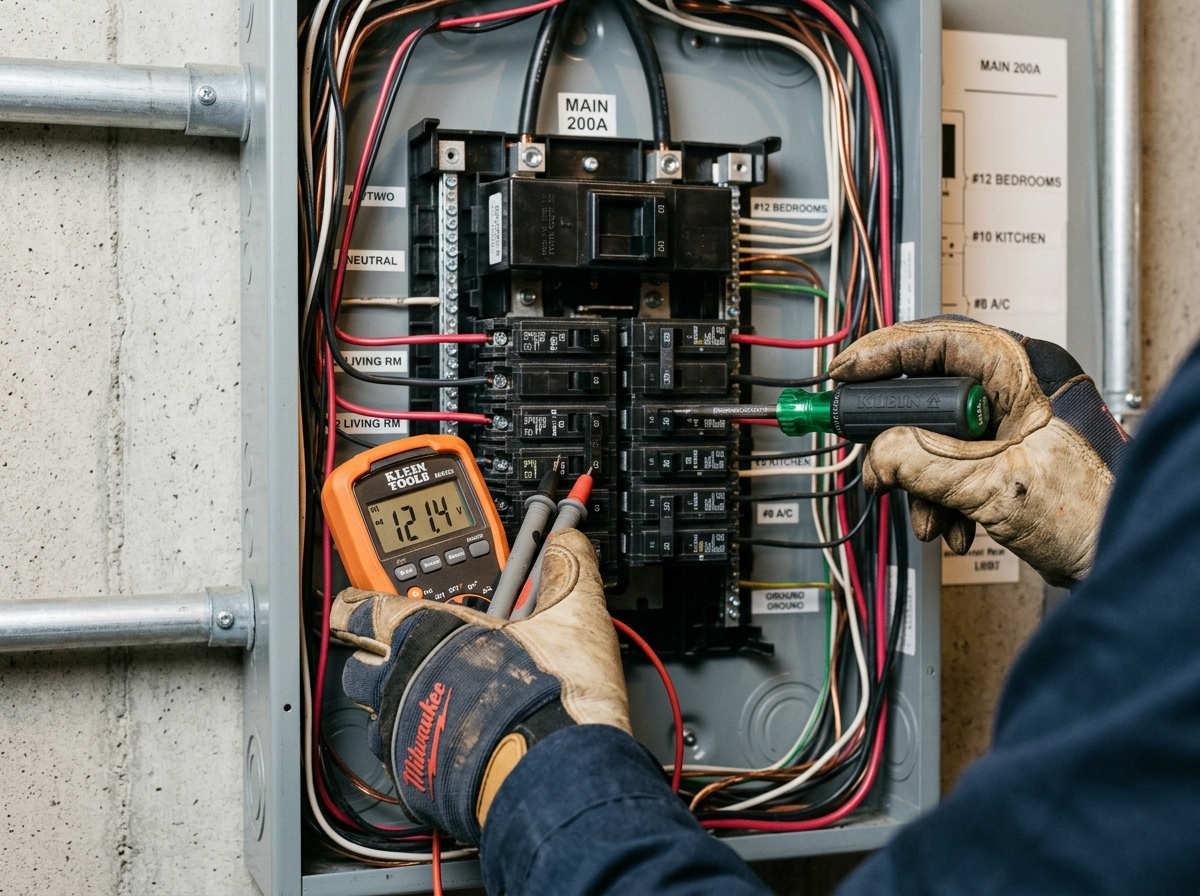
In Bothell residences, electrical service is delivered as a 120/240-volt split-phase system. The neutral wire provides the center-tapped return path for 120-volt current. If the neutral connection becomes loose or corroded—often due to winter windstorm stress on the overhead service drop, corroded meter lugs, or an improperly torqued neutral bar inside an aging breaker panel—the electrical system loses its ground reference. Voltage on one leg can plummet to 80 volts (causing brownouts and deep dimming) while voltage on the opposite leg surges to 160 volts, frying TVs, computers, and refrigerator circuit boards.
Another common Pacific Northwest issue is light dimming during winter cold snaps when residential heat pumps or ductless mini-splits kick into high gear. When a large compressor motor starts across the line, it can draw up to five to seven times its normal running amperage for a split second. If your electrical panel's service conductors or panel bus bars are undersized or experiencing high resistance, that inrush causes a noticeable momentary voltage drop throughout the house.